As a writer, I often reread my own work. You might think this is out of pride or self-importance, but it really isn’t. I reread my own work to see if it holds up to the passing of hours, days, years. I write as much for myself as I do for a more public audience, and I am particularly proud of a poem or essay that still stirs feelings in me months or years after it is written. Rereading a poem I’m particularly proud of is like finding an old photograph that is so beautiful it can speak for people who aren’t alive anymore.
So I am excited to share good news about one of my favorite poems – a poem I read and reread, a poem that is so special to me it’s the first one you’ll read in Neoteny: Poems. This poem has never been published before, but it has been read in public. The poem is called “I Begin to Understand Jo March,” and it was a finalist for The Poet’s Billow 2018 Atlantis Award!
You can read my poem, along with other finalists and winners, here. That link will take you down to my poem specifically (a nice touch provided by The Poet’s Billow), so scroll up to read my fellow contributors. Our bios can be found here.
Why Jo March?
If you haven’t read Little Women, go read it. It’s a book I fell in love with years ago. But as you might expect, I didn’t know the childhood love for this story would grow up with me. I reread Little Women a few years ago and discovered that the story was more complex than my adolescent mind had realized. Then I read it again. And again. And I, in a transitional stage of my life, realized that Jo March was doing something remarkable, and feeling an ache I had just started to know. So I went to the computer and started typing.
This poem is special to me because when I reread it, I feel the rush of emotions that inspired it. The words do what I need them to do. For me, the poem has not worn away with time. It has grown stronger.
I hope you’ll enjoy this poem – and my forthcoming collection – as much as I do.
Embodiment – which leads to embodied art – is the practice of describing life from where you sit, stand, lean. For disabled writers and artists, creating embodied art means taking the nondisabled audience – or the audience who may not share our impairment – into our daily experiences. Embodied art can be loud, political, and sharp. But it can also be quiet, unassuming, and subtle. Embodied poetry will change your mind about the body and the person who lives with it. It is poetry that is unafraid of the body, poetry that recognizes the body’s role in helping shape our daily experiences.
I am excited to share the interview with you! In this interview, Jill asked me about how I incorporate sensory imagery into poetry — which often relies most on visual images — and why I wrote the poem “Faith.” The poem is included in the interview, and you can also read it in my forthcoming book Neoteny: Poems.
I have enjoyed some local press this week, and I can’t wait to share it with you.
On Friday, I met with a student reporter from UNF’s newspaper The Spinnaker. She came to my office on campus and we talked about poetry, teaching, disability in the arts, and, of course, York! Here’s the profile she wrote! There is even a brief video, where York gets his closeup!
Today, I was interviewed live in the Channel 12 studio for First Coast Living. I had a lovely time talking with co-hosts Haddie and Curtis. I also appreciated how the FCL staff showed me around the studio to make sure I was comfortable with the lights, cords, carpets, steps, and props! I felt very anxious about being under those bright TV lights, but everyone was so kind and ready to help me get comfortable. Here’s my First Coast Living segment.
And guess what? I have some more TV spots, blog interviews, and publications on the way! Keep watching On the Blink.
I am excited to be featured on the front page of today’s Florida Times-Union! Last week I was interviewed by the TU’s Matt Soergel, and my feature came out today!
Photo of the newspaper front page where you can see my article.
The article appeared with the headline “Poet write about far more than blindness,” and it was also published on the TU’s website here.
I am excited to announce that my first book, Neoteny: Poems, is now available for pre-order! Click on the lovely book cover below and you’ll travel to Finishing Line Press’s website, where you can order your copy!
Why Pre-Order?
The next two months are my advance sales period. The number of pre-orders for Neoteny during this period will determine the book’s pressrun — how many copies are created. When you pre-order your copy, you are helping ensure more copies of my book will go into circulation. Once the book is published, it will also be listed on Amazon, where others can buy it.
When Will You Get Your Copy?
The book is scheduled to ship on November 15, 2019! Order now, and stay tuned to the blog for updates. I’ll be scheduling interviews and readings to promote Neoteny and share it with my community.
A Special Thank You
Just today, Neoteny was made available for pre-order. And already, some of my devoted friends have reserved their copies. I am so touched and so filled with gratitude at this outpouring of support. I know poetry isn’t always popular, and when I started publishing my work back in 2012, I never expected to find such a warm reception. But I have been surrounded by encouragement, love, and enthusiasm. To each of you who has taken the time to offer kind words, read through drafts, or brainstorm ideas, I am so incredibly humbled, so incredibly thankful.
Now, scroll up and click that pretty cover! Reserve your copy today! And hey, get one for a friend! Neoteny is a lively, joyful collection: it will definitely brighten someone’s day.
I am thrilled to announce that Finishing Line Press is publishing my first book! Neoteny: Poems is a poetry chapbook (a collection of about 35 poems) — and it’s my first solo book! Neoteny will be released at the end of this year!
Here is my beautiful cover, with art by Chelsea Whiteman.
Neoteny will soon be available for pre-order through Amazon and through the Finishing Line website.
Why Neoteny?
This collection is named after a biological term that has always stayed with me ever since I heard it. Some words have their own music, and “neoteny” has always sounded powerful to me. I first heard of this concept in Dr. Stuart Brown’s 2018 TED Talk, “Play is more than just fun.” Brown describes the importance of knowing our “play histories” – the games we played as children and the activities that delighted our imagination. He puts the word “neoteny” up on the screen and explains how humans are the most “neotenous” species.
What is neoteny? It is when a species retains the playfulness, imagination, and plasticity of childhood into adulthood. Biologically, it helps species adapt and survive because they are willing to imagine and explore. Psychologically, it is keeping your child-mind. One wise man said “Become like little children.” Another called it “beginner’s mind.” Neoteny is the willingness to admit we don’t know everything and the eagerness to dwell in possibility.
For me, neoteny is about humility, playfulness, and, most of all, hope. I have built this collection with poems of remembering, love, laughter, and occasional sadness. They are poems that play with even the most serious feelings and experiences. Perhaps these poems are my play history.
Here’s what other poets are saying about Neoteny:
“Neoteny is a remarkable chapbook of ars poeticas, Blind pride and love poems. One poem has me thinking of Edna St. Vincent Millay; another of John Milton. This is an impressive debut.”
“Emily K. Michael’s poems are, to borrow her own phrase, ‘Spoken with brave sweetness.’ Refreshingly lyrical and non-didactic, her work represents a new voice in disability writing, one that is addressed to friends and loved ones rather than to an anonymous and hostile public. This collection creates an intimate space in which insiders and outsiders alike can feel at home.“
“A vital magic occurs when Michael folds the bloom of young romance into the intimacy of care and care-taking that people with disabilities do for each other. This collection has a quiet intense power. The poems will sneak up on you. They don’t shout.“
Jill Khoury, author of Suites for the Modern Dancer
Are you just as excited as I am?
Do you want to read these poems for yourself?
Stay tuned! I’ll be sharing updates, interviews, and insights into the publishing process right up until our release date!
I am excited to introduce you to my friend and colleague, Chris Gabbard. A month ago, Chris published his first book, a memoir called A Life Beyond Reason. After reading the book, I wanted to interview him to hear about his motivations and his writing process. I hope you enjoy this conversation!
If you want to hear Chris read in person, please check out his upcoming events! Chris will be reading from and signing copies of his book at San Marco Books, Thursday, July 11, 6:30 pm (1971 San Marco Blvd., Jacksonville); The Bookmark, Friday, Aug. 2, 7 pm (220 1st St, Neptune Beach); and Midtown Reader, Friday, Oct. 4, 7 pm (1123 Thomasville Rd, Tallahassee).
Chris Gabbard grew up in Palo Alto, California, and has one sibling, a brother named Jesse. Raised a Roman Catholic, he attended St. Francis High School in Mountain View, the heart of Silicon Valley. He worked for a year as a full-time boycott organizer for César Chávez’s United Farm Workers Union, earning $5 a week plus room and board, then studied creative writing at San Francisco State University. For a long period he worked in and then ran his family’s retail irrigation-supply business in Mountain View. From 1983 to 1989 he was the publisher and chief editor of The Short Story Review, the first journal to publish work by Chinese-American writer Amy Tan. He married Ilene Chazan in 1992, and in 1999 he earned a Ph.D. in English literature at Stanford. He now teaches British literature and Disability Studies in the Humanities at UNF in Jacksonville. In 2012 he won the Disability Resource Center Professor Empowerment Award, and in 2017 he garnered the Sigma Tau Delta Faculty Appreciation Award, in recognition of his “Outstanding Commitment and Dedication to the Art of Teaching.”
It was while wrapping up his doctoral work at Stanford that his son August was born with severe and multiple impairments. August passed away in 2013. Beacon Press published Chris’s account of the experience, A Life Beyond Reason: A Father’s Memoir, in May of 2019. Chris lives with his wife Ilene and seventeen-year-old daughter Clio in Jacksonville, Florida.
What motivated you to write A Life Beyond Reason?
I wrote the book for three “official” reasons. First, I wrote it to commemorate August and to celebrate the father-son relationship we shared. As his father, I wanted to assert that August’s life was worth living. Tied in with this motive was my desire to dispel the notion that he was a “vegetable” and that his was a life of suffering. It is true that he lived with significant and multiple impairments, but he was a happy child who took great joy in being alive, and I greatly enjoyed being with him.
Second, I wanted to describe August’s disastrous encounter with modern American medicine. He was born with H.I.E. (hypoxic ischemic encephalopathy), likely due to medical error. In his case, H.I.E. meant that he was a spastic quadriplegic from cerebral palsy, was cortically blind, and profoundly cognitively impaired. And toward the end of his life my wife, Ilene, and I allowed a questionable medical device to be implanted inside him, and this led to his death. So, I wanted to talk about both his beginning and his ending.
And third, as a scholar of eighteenth-century British literature, I study the Enlightenment. This philosophical, scientific, and social movement provided the platform for our modern, globalized world. Embedded within the legacy of the Enlightenment are numerous contradictions that are difficult to untangle. The various facets of my son’s story seemed to embody these embedded contractions.
I had a fourth “unofficial” reason. I had been teaching literature for almost two decades and reading it for much longer. I found myself often thinking: “If I have been teaching it for so long, can I actually do it, that is, write a piece of literature?” So, I set out to see if I could.
Describe the story of the manuscript – how many drafts did you create, how many rounds of beta readers did you have, how did you organize and reorganize the book, etc.:
I spent 4-1/2 years writing the book. One reason that it took so long had to do with not having been able to secure a publisher. I must have written the equivalent of one-hundred drafts. Had I found a publisher early in the process, the book would have gone out prematurely, and I am very glad that it didn’t. In the early stages, though, I didn’t realize how under-developed the manuscript was. The delay gave me the time (against my will) to rewrite, and rewrite, and rewrite. But I believe that it is a far better book because I had to wait.
As for beta readers, forty-five people gave me feedback. All of their comments were useful. Sometimes their silences were telling. Silences gave me clues as to what I was not doing or doing poorly. On more than one occasion, readers asked me basic questions about the facts and/or sequence of the story, and these questions benefited me because they pointed out the gaps, the parts where I was not being clear about the basics.
With regard to organizing the text, this was one of the hardest parts. What to say when—THAT was the challenge! In my first drafts, information was emerging in the form of an enormous, shapeless, jumbled blurt: a yelp of pain. A lot of the time was spent trying to figure out how to unravel this gargantuan and emotive blurt and give the events an order and sequence that would be both intelligible and appealing to readers.
How has your academic writing prepared – or failed to prepare – you for writing this narrative?
E. M. Forster writes in Aspects of the Novel that keeping the storytelling process moving depends on responding to the reader’s primitive, impulsive question, “What happens then?”
Professors like to profess, which means, we like to tell people things, explaining as we go. We feel that we were born to educate. Telling a story is different from writing didactic expository prose. I had to learn how to write in a completely new way. Telling a story is the opposite of writing an essay: you have to learn how to withhold information. You have to silence that part of your brain that really wants to inform and show off.
As a writer of a story (even a true story), I had to respect the narrative process, which requires constant forward movement. Stopping to elucidate a pet topic, no matter how dear, only slows momentum and can create dead moments. So, I had to be very, very sparing when it came to telling people things just because I felt it was important for them to know something in an intellectual way.
What advice would you pass on to another writer seeking to publish a book for the general audience?
By “general,” I assume you mean a non-academic audience. Let me dispel the notion that a “general” audience exists. Publishers want to know what segment of the general audience a writer is appealing to. They will want granular particularity. They will want to see a book proposal that looks a great deal like a business plan. They will want a detailed blueprint of the selling process because they are investing time and resources in your project, and they will need to cover their expenses, if not make a profit, in order to stay in business. And these are tough times for publishers! Who will be the book’s intended audiences? What will be the plan for outreach to these audiences once the book is published? What specific actions will be taken? What are some similar, recently published titles? Did they sell well? Why is the proposed book different from the titles already out there? What does this book have to add to the conversation? What does the author bring to the table that will help promote the book?
Writing the manuscript is only part of the process. The book proposal my literary agent asked me to write come to almost 90 pages. It was that long based on the examples she sent for me to emulate. Doing all of this was very far from what I thought I was going to do, which was, to write a beautiful literary work about my deceased son.
Which moment, episode, or scene in the book are you most proud of and why?
The passage in the book I am most proud of was contained within the excerpt Salon reprinted for Father’s Day, 2019. Salon used the first half of chapter four. That section describes the day I ran with August in his supersized jogger through the Philips–Craig Swamp Cemetery in the San Marco neighborhood and then was caught in the thunderstorm while heading home. I am proud of it because it situated the two of us, August and me, between past and future, in a number of different ways. Paradoxically, it also located us squarely in the “here and now,” the present. For these reasons, it became a pivot point in the story.
Did you find it difficult to write about family and friends who would eventually read the book? Why or why not?
No, not really.In all aspects of the book, I tried tobe careful with regard to accuracy. The name of the friend who attended the birth, Joanne Sasaki (a pseudonym), had to be changed because I had to conceal her affiliation with the institution where she works, which also happened to be the hospital where the birth took place. This had to happen because, for legal reasons, I could not identify the hospital. Outside of that, writing about family and friends posed no problem. Everyone was supportive of the project.
In the book, you describe your resolve to avoid making jokes at August’s expense and avoid remarks that would hurt him if he could understand them. Did you have any moral or ethical guidelines in mind when creating this book?
I have heard criticism directed at parents who have published books about their disabled children, the charge being that they are doing so without the child’s consent, at the child’s expense, and for their own aggrandizement. The child’s privacy is being violated. In sum, the charge generally is that there is something unethical and sketchy about writing publicly about one’s disabled, or even about one’s typically developing, children. I have read a lot of memoirs by parents of disabled children, and in a few cases I can say that the criticism is partially warranted. A few examples occur to me in which the book consisted mostly of the author talking about him- or herself, about his or her life, opinions, and/or scholarship and barely mentioning the child. With this criticism in mind, I went out of my way to make certain that August would occupy the center of the story, with long passages describing him, what he looked like and what he did, his birth, death, and everything in between. This was to be a biography, not my autobiography.
Legitimate ethical questions come up when one speaks on the behalf of a disabled individual. In most circumstances, one should not do this. August though was a non-verbal, non-autonomous person. He could not speak, much less speak for himself. Skeptics may question this claim (and there are such skeptics, especially in some corners of the disability community), but I would respond that the speaker of the question may be unknowingly dismissing a population with which they are unfamiliar. I would suggest that those who claim that there are no non-autonomous, non-verbal people should make a better effort to meet a few. If I didn’t speak on behalf of my non-verbal son, who would?
Books by parents of disabled children serve a valid purpose. Parents need information from other parents in order to become better parents themselves. The parents of kids with impairments need information from other, similar parents even more than do the parents of typically developing ones. If we followed this criticism to its logical conclusion (that these books are unethical), no discussion in any print medium could occur among parents of disabled children. This ethical concern could have the counter-productive effect of shutting down exchanges of vital information, and this shutdown would lead to ignorance, misinformation, sense of isolation, self-loathing, and hopelessness. People in this community need to be in touch with each other, and books are one way to do that.
Moreover, the political consequences of not speaking up by writing about disabled children would be catastrophic. Politicians and the press largely ignore parents of disabled children and their and their children’s pressing needs. Telling these parents that it is improper for them to speak about their children and their needs in any print medium without first gaining their children’s consent and approval (which can’t happen anyway even with mentally cognizant children because they are still minors and so are not legally able to give consent) out of some misguided ideal that we need to protect children’s privacy will only further shut people up. And shutting parents up will reinforce the public’s and politicians’ prejudice that this segment of the disabled population does not even exist. And if they don’t exist, the politicians and the public will think, then we don’t have to think about them. This kind of misguided clampdown will only take us back to the 1910s and 1920s, when the situation were very, very bad.
So, my ethical guidelines in writing the book were simple: they consisted of being truthful, faithful, and accurate when informing the public that a population of non-autonomous, non-verbal individuals such as August exists, that they are more than “vegetables,” that they are full human beings, that they enjoy their own lives, and that they and the families caring for them need the support of a robust social safety net.
Lastly, because the memoir concerns an arrogant and indifferent medical establishment that brought about August’s premature death, I strove to remain vigilant that the story I was telling be fair with regard to the people with whom I had/have a grievance. To this end, I tried to convey some of the complexity of the situation, that the doctors themselves were not entirely to blame, but the system in which they work.
Which memory of August in the book brings you the most joy?
That’s easy: this passage occurs early in chapter seven, when I am changing August’s poopy diaper. It is a moment when I have a sort of hallucinogenic inspiration. I look into August’s eyes and see the face of God. It’s pretty trippy, but it is also central to the book’s theme—that caring for a disabled child will change your life, just not in a way that you might expect.
What are some challenges you encountered while creating this book?
The main challenge I faced had to do with the fact that the story of a disabled child who dies is not one that most people want to hear. Publishers fall into the category of “most people.” One representative of a major house said he “shed a tear” reading my proposal but that he was going to pass on it. When I read this rep’s response, I realized how naïve I had been: people are only going to see this book as a grief memoir.
The inherent sadness the story elicits overpowers the book’s political messages, which are threefold: (1) the fraying of the social safety net, (2) the brokenness of our torts system, especially when it comes to birth-injury cases, and (3) the fact that the FDA has been captured by industry. I am going to have to accept that readers are going to focus on the sadness and overlook what August (through this story) is trying to tell them.
Did early readers or editors ever attempt to soften or sentimentalize realities you were writing about? Did anyone ask you to take a different approach with this book?
In any linguistic system, a speaking agent cannot voice exactly what he/she intends to say. The system forms what it is possible to utter, even to think. So, yes, there was pressure to soften and sentimentalize. If your disabled child dies, and if you want to talk about it, then the linguistic system makes place for only one approach: sentimentality. One important person, I won’t say who (she turned out to be extremely helpful), wanted me to drop all reference to the political themes mentioned above. To her mind, politics wandered off the sentimentality script. She pressed me for a sweet, or should I say saccharine, story. However, I don’t blame her. Publishing is a business. People need to earn a living, and they do so by selling books. It is not the job of people in the industry to provide me with a platform for a rant. So, if I wanted to play in that league, I had to learn the game. That said, I managed to get through the editorial process saying everything that I wanted to say. I have to thank the folks at Beacon for this. They were great! In fact, my editor showed me ways to better express what I wanted to say. In the end, I came out with a better book than I started, thanks to her. So, I am very happy.
Many stories of disability come under the pressure to be “inspirational,” where the disability is minimized or exchanged for spiritual epiphanies. Did you experience this pressure?
The answer to this question goes back to the previous one. As a disability studies scholar, I started writing the book absolutely hell bent on NOT producing anything “inspirational” or anything that minimized disability in exchange for spiritual epiphanies. That said, the process of writing is one of discovery, and the writer has to go wherever the process leads, even if it is to a place he didn’t initially want to go. In my case, the process led me to places I did not imagine I was going to go.
In a certain light, the book is “inspirational” for those who want to see that quality in it. And it is true that I did stumble upon spiritual epiphanies that would not have happened had disability not been SOMEWHERE in the picture. The spiritual epiphanies (by the way, epiphanies are evanescent) emerged because I was meditating on the Enlightenment. By the end of the writing process, I found myself on the other side of the Enlightenment, “beyond reason,” if you will. Here is why: the rational thing to have done with August would have been to smother him with a pillow. An enlightened, rational man would have done just that, or its equivalent; Enlightenment man would have found some way to kill his child without getting caught. (Not getting caught would have been easy.) And yet, there was no question in my mind: I would never do that.
So, once I realized that I would not do the totally rational thing, I had to let go of the ideal of rationality. Hence, the book’s title. Moreover, once I moved beyond the Enlightenment imperative that every individual conduct their life adhering 100% to reason, there was no other place for me to go but back to the spirit. Ever notice that there aren’t many options in life? The only third way, the only alternative to rationality on one extreme end and spiritualism on the other extreme end, is an amalgam of the two. So, to sum up, your question’s wording (“disability [was] minimized or exchanged for spiritual epiphanies”), with all due respect, is a bit reductive. I arrived at a different spiritual state through the process of writing a story, one in which there was a disabled person.
What have you learned about the publishing process?
I have learned that it is a heck of a lot harder to publish a book for a general readership than I realized.
Let me tell you how the book came about. I published a piece in 2010 in the Chronicle of Higher Education about August that prompted a literary agent to contact me. She was just starting out on her own in the business. She wanted me to write a book. I said “no” to her at the time because August’s caregiving was too time consuming for me to write a book. Then, after August passed away in 2013, I contacted her about writing the book. By that point she had taken on a lot of big name clients and wasn’t enthusiastic. She had progressed into the $$$ projects. But she agreed to take me on (reluctantly), mainly out of a sense of obligation. I don’t think I would have been able to find a good, effective agent on my own. Finding an agent is actually very hard to do. It’s almost impossible. Without an agent, a project like mine could never have gotten off the ground. I would have had to publish my book on CreateSpace (Amazon), which is what I was fully intending to do if no press would have me. So, while I did a lot of hard work to make this book happen, I also was very, very, very, very, very, very lucky. I don’t think I stressed the word very enough in that last sentence.
If you could tell your readers to underline one passage from your book, which would it be and why?
There are two:
This one sentence in Chapter 5: “If knowledge is power, imagination is destiny.”
And this from the Afterword: “Windmill-wings blue surrounds this spot of Laughing Orange—the laugh of Medusa. But I still find myself in a quandary: in which of the two colors does the truth lie?”
Today my essay, “Remaking the Ideal Teacher,” goes live in the Disability Futures series of How We Get to Next. This piece is among a series of essays written by disabled writers and curated by Kenny Fries. Here’s how my piece begins:
Two weeks into my summer writing course, I stare down a class of rowdy college students. I’ve positioned my guide dog beneath the teacher’s desk. I hold a stack of handouts and wait for silence.
I don’t mind waiting. I can outlast their chatter until the students become unnerved by my wordlessness. I won’t shout over them. I’ll stand here, tap my foot, grin at the decorous few in the front row. Eventually they will all stop talking to one another, and the lesson can begin.
After a few seconds of undiminished conversation, my nascent plan is broken by a huge voice: “Hey! Quiet down! Can’t you see she’s ready to start?”
Abashed, the students shuffle into silence, some muttering apologies. “Sorry, man. Sorry, professor.”
I smile at the student sitting in the leftmost seat of the second row—he’s a dad, a former Navy SEAL. “Thank you, Keith.”
He grins back. “Thought you could use a little help.”
Keith’s booming tone impresses me. But I push his voice aside as I consider several different replies. I want to say, “Thanks but no thanks, I could’ve handled it myself,” or “I really didn’t mind waiting.” Or even, “You’re a sighted man and I’m a blind woman — and you’re older than me. Students will see you as the natural authority.” Despite these ready-made responses, I let the moment go.
The March issue of Wordgathering: A Journal of Disability Poetry and Literature features my essay, “I Am Reading, I Am Read.” This piece is part of the Gatherer’s Blog — a special column where disabled writers talk about the writing life. In my essay, I explore the challenges of learning to read my poetry in public, challenges I learned to manage with the help of dedicated and resourceful loved ones. Here’s how the piece begins:
Every table in the cafe is occupied. Wooden chairs scrape and squeak against the bare floor. Surly employees set down plates of sweet potato fries, Cuban sandwiches, fresh croissants. The espresso machine hums and whirs from the hidden kitchen, and we celebrate its rare functionality with gusto.
I wait against the window as my host arranges the microphone and speakers. The speakers are boxy, incongruous among the blond wood of tables and chairs. I take up my position before the large unshaded window. My guide dog, a black Labrador, lies peaceably at my feet. He enjoys his patch of sun-warmed floor, where the smells of countless breakfasts have been fossilized. He is calm, his leash secured under my foot.
I cherish the small relief that I am not holding the leash; I know it will transfer my anxiety to him. I face the customers, tune my ears to the genial clinks of forks and plates. My dog sighs and his collar jingles. My friend Abigail secures a lapel mic to my collar, asks me to test the sound.
Everything is ready. I have been introduced. I open my big black binder and raise the poems to eye level.
Read the full essay here. Explore the rest of the March issue here.
As a professional woman, I often receive praise for overcoming my disability:
“I admire how you don’t let blindness get in your way.”
“You are where you are because you overcame your vision loss.”
“You show that with hard work, anyone can overcome a disability.”
“You’re an inspiration because you don’t let blindness stop you from living your life.”
I am an English teacher. I can’t let these statements go unexamined.
I am a poet. I won’t leave lies unexposed.
Overcoming a Disability vs. Living with a Disability
Overcoming means that the problem itself is no longer a problem. According to the dictionary on my computer, to overcome means “to defeat (an opponent or obstacle), to prevail, to succeed in dealing with a problem or difficulty.” The idea of overcoming is so common in conversations about disability that we, the disabled, regularly use the term overcoming narrative to describe a story where a disabled character is healed, where the disability itself is removed. This is the kind of story where the blind person learns to see and the wheelchair user stands up at the end. Many people view these stories as triumphant: Look how the mind achieves victory over the body!
But living with a disability defies overcoming.
When you live with a disaiblity that cannot be cured – a chronic illness, sensory impairment, learning difference – your daily life is about adapting and planning, not about overcoming. You brainstorm workarounds, backup plans, lifelines. You know who you can call as emergency support when your strategies fail — or more likely, when someone responsible for providing accommodations drops the ball.
Ever since I was little, I have been surrounded by loving parents, teachers, and friends who have helped me brainstorm these workarounds so I can live happily as a blind person. Here are some of my favorites:
Mom labeled all the household appliances with puffy paint so I could wash clothes, cook on the stove, and run the dishwasher by feeling the settings I couldn’t read.
My mobility teacher taught me to walk with a white cane so I could travel safely and confidently.
My vision teacher taught me braille so I could label spices, makeup, and other personal items that are hard to identify visually.
My parents and friends helped me find kitchen utensils in bright colors that would contrast with whatever I was cooking. I have bright purple oven mitts and bright red cutting boards. This helps me see what I”m handling in the kitchen.
My friends have helped me experiment with dark sunglasses and hats so that I can work in environments that are too bright for me. I wear my sunglasses constantly and keep a pair in every purse I use.
My blindness is still a significant part of daily life. I cannot drive a car, read most menus in restaurants, read many labels at the grocery store. I cannot identify people by sight unless they speak first. I cannot see to navigate safely in most environments. I cannot read many of the apps on my phone. I cannot identify paper money without help. I cannot paint my own fingernails or toenails. Bright lights and background noise are hard for me to handle. This is not a complete list. To list any more cannots is incredibly depressing.
I am happy in my life and I have found ways to complete daily tasks. But I have not overcome my blindness. It is not a foe I have learned to defeat or a barrier I have crossed once and for all. I can’t plan and prepare exhaustively enough to remove every visual complication from my daily life.
Overcome the Lies: Reveal the Truth
Several factors are being mixed up here: success, sameness, and inspiration.
Most of the time, people do not see what I am struggling with, or they see me in an environment where I am comfortable. They call this vision of me success. They see a blind woman who doesn’t appear to be wrestling with visual tasks, so they assume that I have “overcome” the blindness. They do not realize all the work I have done behind the scenes, the advice I have asked, the trial runs I have made with friends and family.
Most people have a limited repertoire of disabled characters in their daily life. I am often the first blind person they have seen aside from TV — and usually the first disabled person they have talked to. They don’t have an extensive framework of examples to draw on.
When I was in guide dog training, a volunteer approached me and said, “You must have SOME vision.” I asked why she thought so, and she continued, “Because you walk so confidently. How could you walk so well if you were completely blind?” By assuming that sight is needed to walk confidently, this woman was exposing her very narrow definitions of confidence as well as her limited range of examples. Perhaps she had never seen a completely blind person walk confidently. I have.
Our bodies are designed to flourish, to make the best use of the resources we have. “Success” is often confused with “sameness”: We label someone as successful when they have achieved the goals we have achieved. In this mindset, difference stands in the way of success — The woman thinks, “If I would be scared to walk forward without sight, how could any completely blind person walk confidently?” This is logical, but terribly unimaginative.
You do not know how you will do something unless you are actually doing it.
I can plan how I will cross a crowded room with my guide dog, but my experience may or may not match my best plans. Sometimes the task is much more difficult — a person crosses my path, distracts my dog, or steps out in front of me. Sometimes the task is much easier than I could have hoped for — my dog smoothly guides me around outstretched legs, bypasses the table of appetizers and curious strangers, and helps me find a chair. Whether a task goes poorly or well, I have more information to work with for my next endeavor.
And inspiration? Inspiration is when we are completely blown away by what seems like an impossible reality. We see someone doing the impossible, and we feel excited! We want to talk about the indomitable human spirit and the drive to work and create. These are all admirable traits. I love to be inspired and to inspire. I don’t like to meet people who are too jaded to be inspired by daily life.
The problem is that disabled people are not expected to flourish. So when we do flourish in our daily lives, it is seen as remarkable — rather than a reality we can all work toward. Inspiration is too much of a fluke, and it’s too individualistic. Inspiration doesn’t call to mind a community of hardworking people with and without disabilities. It’s a solitary beacon – one disabled person who has overcome their issues to shine forth.
Because you cannot inspire and falter. If you have inspired others, you are not allowed to have difficulties, bad days, frustrations. Your job becomes inspiration. You become the blind girl who doesn’t act blind — and what a relief! If she doesn’t act blind, then we don’t have to appreciate how she might be different, to anticipate what she might need.
We will all flourish at different thresholds and in different environments. Disability does not disqualify a person from flourishing, from enjoying life. Not every disabled person needs to have a career, but they do need a community that respects their right to belong.
We need to make room in our minds for different kinds of flourishing. We need more pictures, more stories, more templates for how humans can live in bodies and minds different from our own. We need imagination and empathy — the eagerness to inspire others by how we welcome a range of abilities.
Below is a call for submissions from Nine Mile Magazine.
Call for Poetry
Nine Mile Art & Literary Magazine
Special Issue: Neurodivergent, Disability, Deaf, Mad, and Crip Poetics
Publication Date: Fall 2019
Guest Editor: Diane R. Wiener
Background
Nine Mile‘s Fall 2018 issue (Vol. 6, Issue 1) included a section called “Other Engines,” devoted to the work of neurodivergent writers. Our Fall 2019 issue (Vol. 7, Issue 1) will be devoted entirely to the work of self-identified Disabled, Deaf, Mad, and Crip poets, with particular attention paid to Neurodivergent—including Autistic—poets. Neurodivergent, Disability, Deaf, Mad, and Crip poetics are at the heart of poetics, well beyond the too-often hurtful and ignorant ways in which disability is used as a metaphor or to forward a storyline. Neurodivergent, Disabled, Deaf, Mad, and Crip poets (whether or not we write about disability) must in our view be represented at the center of poetry publishing. (More information is below about the Special Issue and Nine Mile.)
Submission
For consideration, please submit 10 to 15 poems in Word or Text by July 1, 2019 to Diane@ninemile.org, with the subject line “Fall 2019 Submission.”
Previously published work is welcome. If accepted, it will be the author’s responsibility to acquire republication permission from the appropriate source(s).
We are not equipped to accept video content or visual images, at this time. Please only submit written poetry.
Please also include:
your name, email address, and home address
a paragraph about yourself (background, achievements, etc.)
a statement about your aesthetic intentions (why and how you write “the ways you do”)
a photograph of yourself
If your work is accepted, you will receive $5 per published poem.
About Nine Mile Magazine
Nine Mile Art & Literary Magazine publishes twice yearly, showcasing the best work we receive from authors whose work, energy, and vision are deeply entangled with life.
At Nine Mile, we are committed to featuring diverse writing by diverse writers, including: disabled writers/writers with disabilities; Writers of Color; writers with marginalized genders, sexual and asexual orientations, religious/nonreligious identities and belief/non-belief systems; young and senior writers; experienced and never-before-published writers; and writers from outside the proverbial mainstream. We are likewise committed to producing inclusive and accessible content, in multiple formats. Poetry is everyone’s art.
For more information about NineMile, visit our website.
More About This Special Issue
Since 2007, the online journal, Wordgathering: A Journal of Disability Poetry and Literature (Editor-in-Chief, Michael Northen), has done stellar work in featuring disability poetics, and literary work by and about disability. However, Neurodivergent (including Autistic), Disabled, Deaf, Mad (including Emotionally Variant and Mentally Ill), and Crip poets have generally not been well represented in other mainstream or outlier literary journals, magazines, and anthologies. Moreover, we often do not feel welcomed to or within literary conferences and creative writing spaces, both public and academic, due to exclusion whether intended or accidental.
The groundbreaking collection, Beauty is a Verb: The New Poetry of Disability (edited by Jennifer Bartlett, Michael Northen, and Sheila Black; Cinco Puntos Press, 2011), disrupted this pattern, in its foregrounding of poets with physical disabilities. In particular, Bartlett’s recent essays in Poets & Writers and The New York Times (including new work by disabled poets, published in August, 2018), and Jillian Weise’s contributions—as herself, and as Tipsy Tullivan (via social media, and in myriad other venues)—have taken issue with the exclusionary trend. Increasingly, commentaries about these issues are appearing by other disabled and nondisabled poets and writers.
This Special Issue is part of NineMile‘s ongoing commitments, in these and many other important areas.
I have been rereading Charles Dickens’ Great Expectations, as it’s one of my favorites — and one of my few digressions from contemporary nonfiction or poetry. I first encountered this book in an AP Literature course and fell in love with its humbler characters. I love and hate Pip, of course, as I expect most readers do, and I never had any use for Estella or Miss Havisham. But I adore Jo Gargery and John Wemick with each rereading.
When I was first reading GE, I focused mainly on plot and style — trying to keep all the twists and turns of Victorian fiction in my head while I cherished Dickens’ prose. But with this rereading, I was astonished to discover something I had missed.
Dickens can write everyday inclusion.
If I think of disability in Victorian fiction, I am burdened by characters like Tiny Tim from A Christmas Carol. Tim, the poor crippled boy whose very survival depends on Scrooge’s reformation, has become the poster-child for disability as inspiration — the idea that disabled characters only serve to teach moral lessons to nondisabled characters. You’ll never see Tim get angry, throw his crutch at someone, or wax despondent about his poor health because his job is to be cheerful. I did not know Dickens could do better with disability.
But GE presents at least two portraits of disabled people cared for at home and incorporated into the daily lives of their families. First, Mrs. Joe, Pip’s older sister and the abusive wife of dear Joe the blacksmith, is injured while Pip and Joe are from home one evening. After her injury, she is unable to dress or feed herself and requires a slate and chalk to communicate basic phrases. But Mrs. Joe receives care at home when Biddy, a local girl, comes to live at the forge; Biddy dresses her, feeds her, and sees to her needs. Neither is Mrs. Joe neglected by her husband, who often takes over her care in Biddy’s absence. These characters do not express resentment, distaste, or irritation with their need to care for Mrs. Joe. They lament her injury but continue to give her the best care they can.
Even though Pip soon leaves the forge, he shows us another portrait of inclusion when he visits the home of John Wemmick. Wemmick works for Pip’s guardian, the formidable and austere Mr. Jaggers, and famously has his “London sentiments” and his “Walworth sentiments” — sharply defining the difference between his gritty work life in London and his innovative domestic comforts in Walworth. At home in Walworth, Wemmick has designed his own castle, complete with flag, drawbridge, and garden. He lives with and cares for his elderly father, who he affectionally calls the “Aged Parent,” “Aged P.,” or “The Aged.”
The Aged P. is hard of hearing, and Wemmick has devised several at-home adaptations to make his father more comfortable. The Aged knows when Wemmick has arrived home because a little door in the wall opens to reveal his name. This contraption, a Wemmick invention, also includes the names of other frequent visitors to The Castle, and as Wemmick himself says, “It is both pleasant and useful to The Aged.”
Pleasant and useful — the two essentials of inclusive design. When Pip first meets The Aged, Wemmick says, “Nod away at him, Mr. Pip; that’s what he likes.” And as the visit continues, Pip is encouraged to “give him a nod” and he obliges. The Aged P. is also delighted by the daily firing of The Castle’s canon, which Wemmick has knocked up for his enjoyment. And Dickens reveals that Wemmick’s lady friend, Miss Skiffins, has a high regard for The Aged.
Like Mrs. Joe, The Aged’s disability does not exclude him from tender family care — even at the center of the household. Wemmick consistently thinks of ways to adapt The Castle for the comfort of Aged P. and does not seem to begrudge these changes to his daily life. Indeed, Pip shows us that Wemmick’s Walworth residence is a refuge from the hard life of London, the life that turns his mouth into a rigid “post office.”
Before Mrs. Joe’s injury, the forge was not a happy home for Pip, but after her injury, the forge’s inhabitants find the right balance. It develops into a peaceful and restful place, even as Pip grows dissatisfied with himself and his social status. Pip resists happiness at the forge and will spend the rest of the book seeking a happy home like The Castle — a place of acceptance and invention.
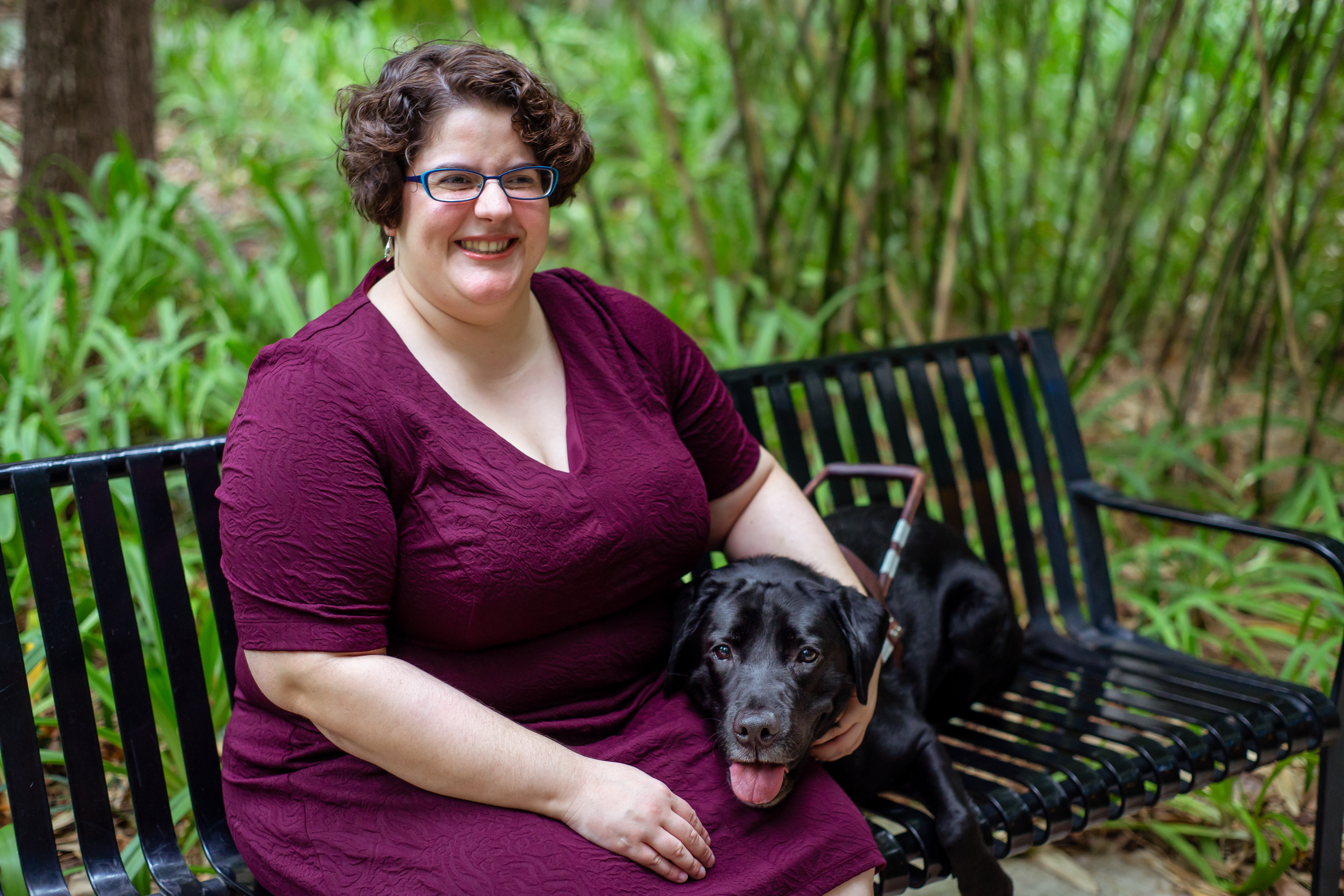
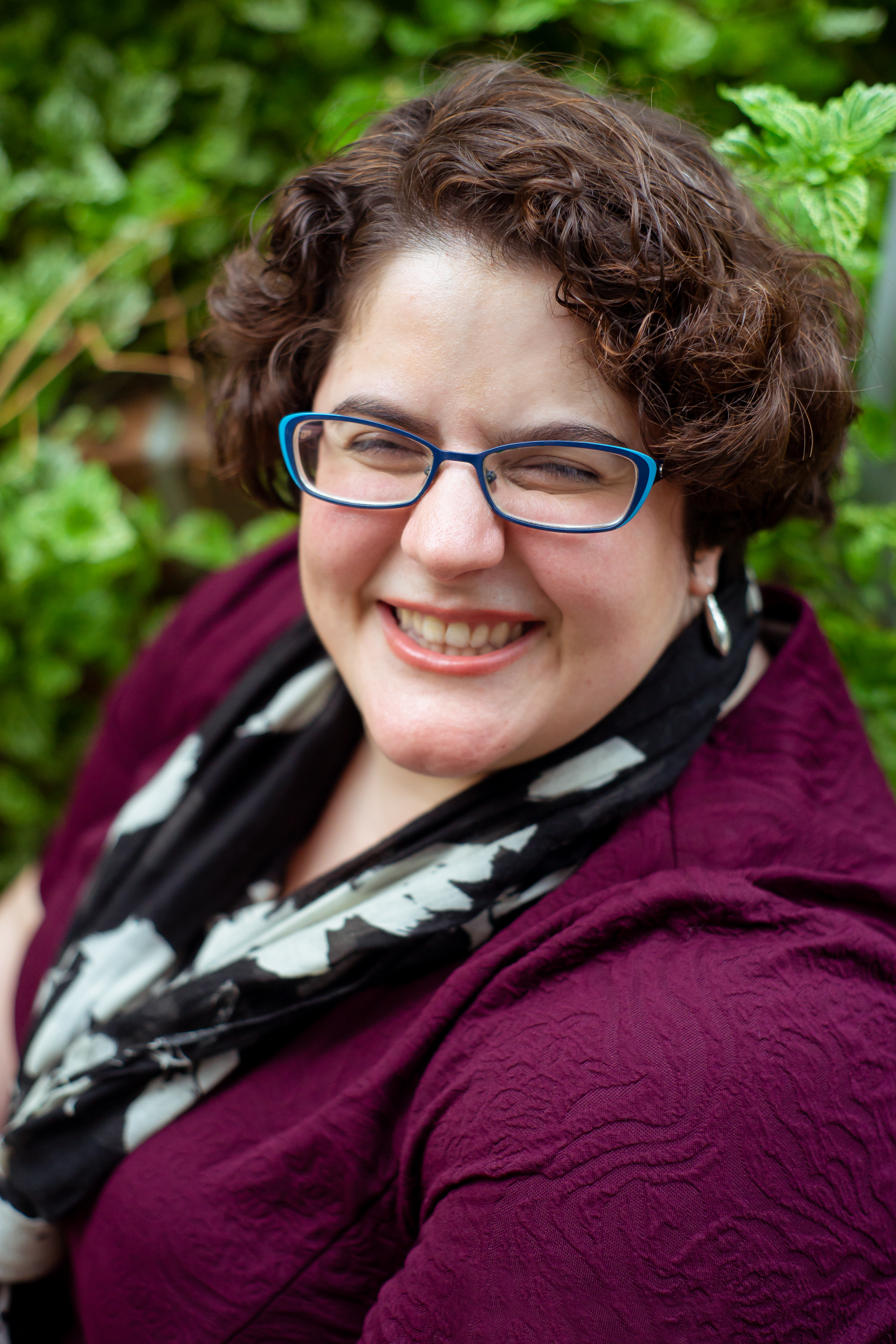
For publications and speaking opportunities, I’m often asked for a professional photo. Because I can’t take my own selfies, I’ve had to rely on the same couple of photos – either the product of a professional event or a kind friend with the patience to photograph me. Often these pictures are years out of date.
As a blind woman, I am rarely comfortable having my picture taken. I am extremely light-sensitive, which means a necessary flash leaves me squinting in pain. I can’t visually locate the photographer just before the click — whether it’s a professional with a tripod or a friend with a selfie stick. And the need for instant immortalizing of moments never gives me enough time to learn where I should look or get in position. Even in formal settings, most photographers don’t know how to guide me quickly. Despite these visual challenges, I can see well enough to be unhappy with the photos of myself that result. So the inevitable picture-taking at weddings, holidays, and life events fils me with anxiety: I feel I always need more time, and I don’t know how to communicate what I need quickly. The rest of the group is ready and I’m still asking, “Where do I look?” People can’t answer and hold their smiles at the same time.
I know I can photograph well, but I require more time and attention than the average sighted person. I need the photographer to count down to the flash — a trick I discovered during an exceptional portrait session I had in high school. Knowing that I was unhappy with the rushed photos we were required to take for the yearbook, my mom insisted on taking me for glamor shots, and over the course of three hours, the inventive and courteous photo team helped me figure out my process. If the person with the camera counts to three right before the flash, I can keep my eyes closed up to the moment when the photo is taken: I open my eyes as the camera flashes and I don’t have time to squint. This trick is a pain-free option that helps me get photos I enjoy.
After relying on an outdated photo for several events this year, I decided it was time to try another professional session. I contacted Chelsea Whiteman, a friend and former colleague who runs her own photography business. I explained that I needed professional portraits for my writing gigs, and I explained my apprehensions and challenges. Chelsea was eager to work with me — but she reminded me that her style is different from traditional studio portraits. The pictures would not look like updated yearbook photos or department store holiday prints. I had no idea how her perspective would translate for photos of me, but I wanted to find out.
Chelsea helped me choose a location and time. I explained my sensitivity to light, and she suggested that we take our pictures in an outdoor setting at dusk. She also recommended that I wear a solid color as patterned fabrics did not photograph well. I appreciated the advice. I chose a solid dress and a patterned scarf that could be added for variety.
I also explained my insecurities about not being prepped for each shot. I asked Chelsea to be very specific in how I should stand and angle my body as well as where I should look. I asked for some head shots, some full-length portraits, and some cute photos with York. Chelsea took all this information on board and prepared for our session.
On the evening of our photos, we were accompanied by Chelsea’s partner Dylan and my friend Michele. Dylan assisted Chelsea, and Michele held York while I was taking solo photos. Michele was later called upon to make very convincing cat noises so York would look at the camera.
Chelsea had chosen the session time well. I was able to take all of our photos without my sunglasses. We moved throughout several green areas, and most of them worked well for our photos. Sometimes I had to say, “I think the light is too bright here,” but often, Chelsea picked up on my discomfort before I said anything. She would say, “I think you’re not going to be comfortable here, so let’s just move on.”
For each photo, Chelsea observed how I was standing naturally before making any adjustments. She invited me to sit down, look up, look over my shoulder, put my hand on my hip, tie or untie my scarf – all to help me feel comfortable and convey a sense of liveliness in the photo. Sometimes she climbed up on the bench beside me and took the photo from above. At every stage of the session, she provided a running commentary on how the shots looked from her side and what I was doing well.
As the session progressed, I felt increasingly confident and photogenic. I felt that I really had something to offer the camera and that these photos would be a complement to my professional presence. Chelsea was clearly enjoying the session, and she easily worked around my visual challenges. Her professional calm and skill reassured me that my visual circumstances would not get in the way of a good photo.
When I am happy with a photo of myself, it is not just because I like the way I look. Chelsea’s photos remind me that, in the hands of a skilled and conscientious photographer, the time and effort I require will pay off.
Once again, it’s time to report on what I read this year. I set myself the Goodreads challenge of 35 books, and I read them all! As usual, the most memorable books get mini-reviews. And I’ve included links to the two full-length reviews I wrote this year. Sprinkled throughout this list you’ll find my favorite books of the year, so keep your eyes open for the On the Blink Noteworthy Books of 2018!
Jo’s Boys by Louisa May Alcott
This is the final installment in Alcott’s Little Women quartet in which she explores more sophisticated themes: young women who choose a career over marriage, authors who tire of their fame, and lives that don’t tie up neatly. It’s a solid presence in the saga of the March family.
Word by Word: The Secret Life of Dictionaries by Kory Stamper (On the Blink Noteworthy Book of 2018)
Stamper’s humorous style and meticulous research are a delight for any language lover! Read, read, read this!
Wishful Drinking by Carrie Fisher
A hilarious light read. Fisher narrates the audiobook, and she does a wonderful job!
Louisa May Alcott: A Personal Biographyby Susan Cheever
As with Cheever’s biographies of E.E. Cummings and the Transcendentalists, this book does not disappoint. By turns heartbreaking and ecstatic, Cheever’s style offers a rounded portrait of Alcott—and all her bizarre life events.
Crow Planet: Essential Wisdom from the Urban Wilderness by Lyanda Lynn Haupt
A masterful author, Haupt create ecological nonfiction rife with poetic and philosophical references. Her discussion of crows is smart, astonishing, and empathetic.
The Grammar of God: A Journey into the Words and Worlds of the Bible by Aviya Kushner (On the Blink Noteworthy Book of 2018) Completely outstanding exploration of the differences between the Hebrew Scriptures and English translations. This book is a gem — detailed layered research interspersed with a nuanced and captivating family story. Again, the audiobook is a wise choice here. I needed a reliable narrator to pronounce all the Hebrew passages.
Dodger by Terry Pratchett
This novel is Pratchett’s hilarious and inventive companion to Oliver Twist. For Dickens fans, there are many enjoyable moments, but the book also stands alone in true Pratchett style.
Dear Committee Members (Jason Fitger #1) by Julie Schumacher
This novel consists entirely of letters and emails written by Jason FItger, a train wreck creative writing professor who gaily mixes his professional and personal lives. If you work n academia, you will love it!
The Shakespeare Requirement (Jason Fitger #2) by Julie Schumacher
In the second installment of Jason Fitger’s story, Schumacher expands the academic universe to include other charmingly self-involved scholars. This novel is much longer but equally hilarious.
The Good Neighbor: The Life and Work of Fred Rogers by Maxwell King (On the Blink Noteworthy Book of 2018)
Heartwarming, uplifting, and encouraging. The audio version is narrated by LeVar Burton and features the iconic Mr. Rogers music. A beautiful book.
84. Charing Cross Road by Helene Hanff (On the Blink Noteworthy Book of 2018)
Another delightful epistolary story – and the audio is narrated by several cast members. This book is a lovely reminder of how much heart we put into letters, and why we should always write and save letters.
Emily K. Michael
Emily K. Michael is a blind poet, musician, and writing instructor. She serves as the poetry editor for Wordgathering at Syracuse University. She is also a poetry mentor in AWP’s Writer to Writer program. Her work focuses on music, embodiment, teaching, and ecology. Emily is passionate about birds, medieval history, singing, and guide dogs.
Pre-order My New Book
Purchase Neoteny
Email Subscription
Enter your email address to subscribe to On the Blink and receive new posts by email.