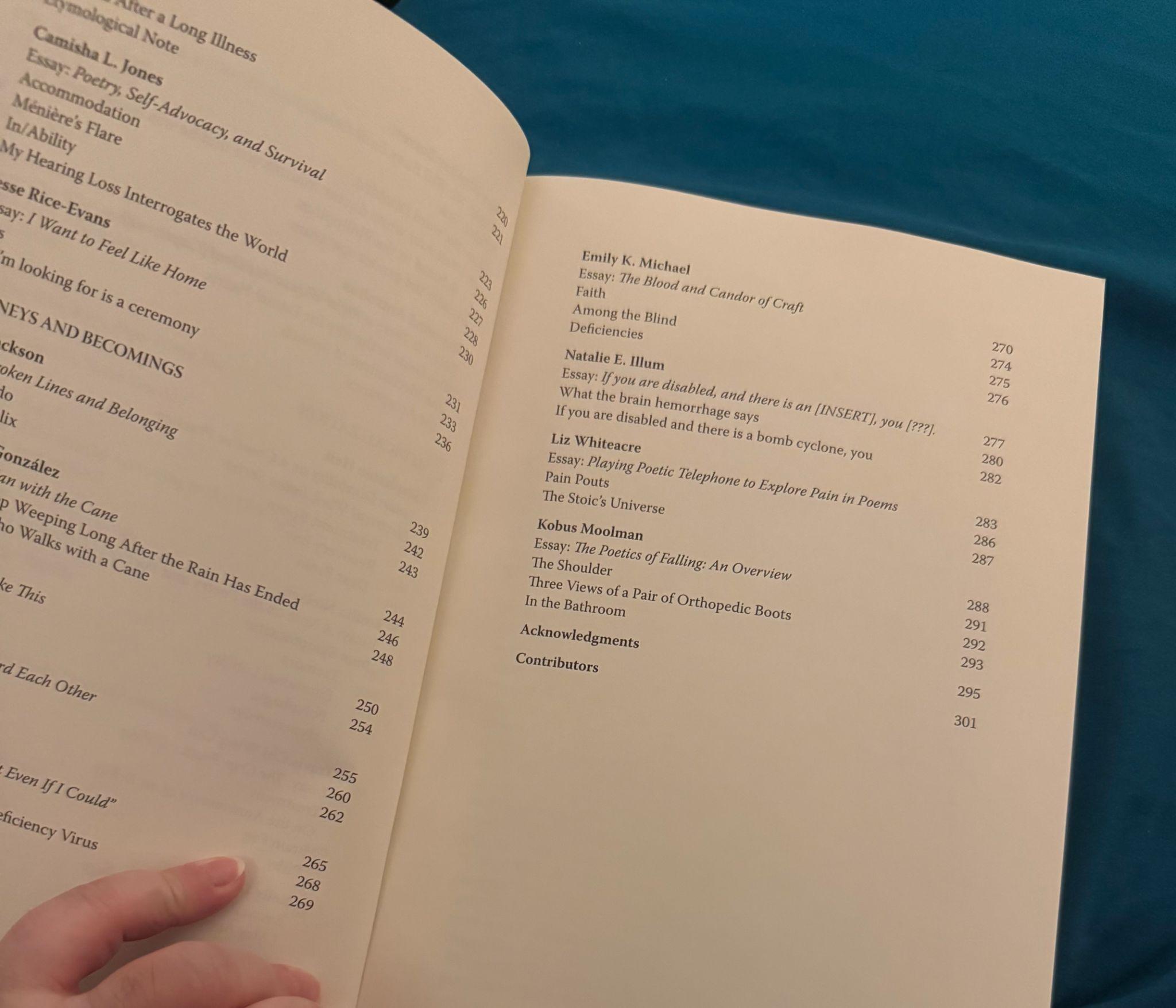
Today I received an early copy of Every Place on the Map Is Disabled: Poems and Essays. This new anthology from Northwestern University Press features three of my poems and one of my essays — alongside the extraordinary work of contemporary disabled poets. I recognize many of my co-authors — like Jill Khoury, Eli Clare, and Meg Day — and I’m thrilled to be included with them.
My poems and essays appear in the fifth section of the book: Journeys and Becomings.
The Poems
“Faith” is a poem that explores secular and sacred beliefs, mapping a world where grace is found through mutual understanding.
“Deficiencies” is one of the “dog poems” — and my only poem to be translated into a painting. The two dogs under the table are the real stars here; they know something I’m still trying to figure out.
And “Among the Blind” is coming into print for the first time. This poem tries to capture the intense comfort and strength of being surrounded by one’s tribe and not having to explain oneself to others. This is my valiant response to those who see disability as tragedy or deficit.
The Essay: “The Blood and Candor of Craft”
This piece was originally published in Wordgathering in the Gatherer’s Blog, a series that features writers on writing. In this piece, I ask what disability poetry is supposed to do — and what it can do. It is a defense of poetry as a help and a miracle.
———-
The book is available for pre-order on Amazon. I hope you enjoy it!
I attended and presented at Tudorcon for the first time this weekend! I chose the “Tudorcon from home” option which allowed me to view all the talks on Zoom, participate in live Q&As, and present my talk digitally.
I was impressed with the accessibility measures taken by the conference organizers. All sessions were recorded, and all slides were shared in real time. When my screen reader wouldn’t read the Canva program aloud, the host immediaely sent me a PDF. I have attended much larger conferences with less satisfying results. The Tudor enthusiasts are kind people!
My presentation was called “Love, Language, & Lyric in Tudor England: A Poet’s Workshop.” You can watch it here:
I created a live resource page to go with my talk. You can view it here.
Last year I had the privilege of teaching a creative writing class with an extraordinary group of high schoolers. Many of these students had taken previous classes with me and were interested in my work as an author. In a lesson on sensory details, I shared my poem “Cello.” After enthusiastically analyzing the poem, one student asked, “Ms. Michael, is ‘Cello’ one of your favorite poem children?”
I found his question so endearing that I began to contemplate my “poem children.” I do have favorites — poems that repay me with insight even after I’ve reread them, poems that navigate me effortlessly to their white-hot kernel of inspiration.
Since its publication in 2014, “Cello” has repaid my efforts. I wanted to turn the liquid vitality of music into words. I was inspired to write it based on this song:
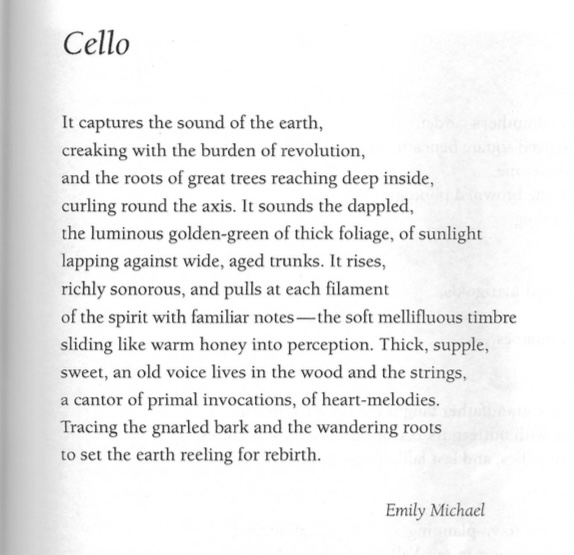
“Cello” first appeared in Artemis Journal in 2014. Here’s what it looked like on the page:
If you’re unable to read the text in the photo, you can click the link in the opening paragraph and read or listen to the poem. I recorded the audio.
“Cello” made an impression on the editor of Artemis. Five years later, it was recommended for a unique publication opportunity: a pamphlet for Carilion Roanoke Memorial Hospital called Poems in the Waiting Room. These pamphlets were designed to offer poems of peace and healing for families with loved ones in the hospital.
Also in 2019, “Cello” appeared in Wordgathering: A Journal of Disability Poetry and Literature, linked above. And it was included in my first book, Neoteny: Poems from Finishing Line Press.
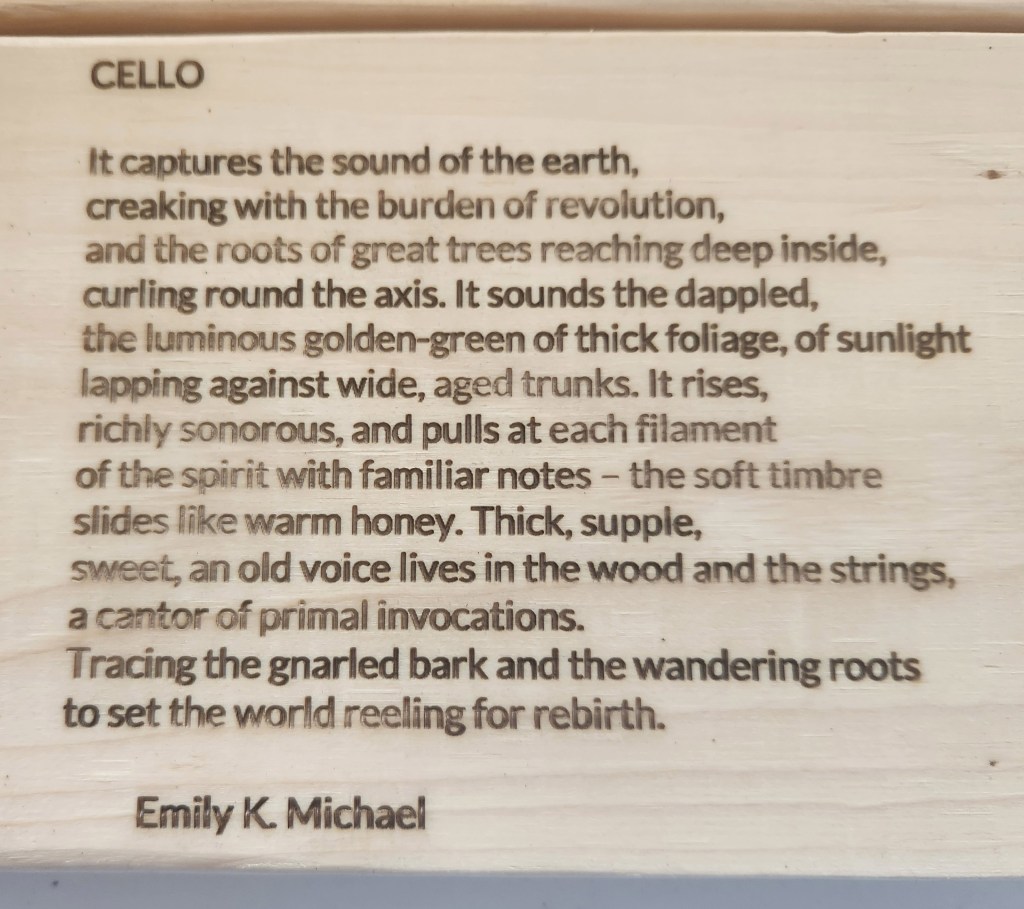
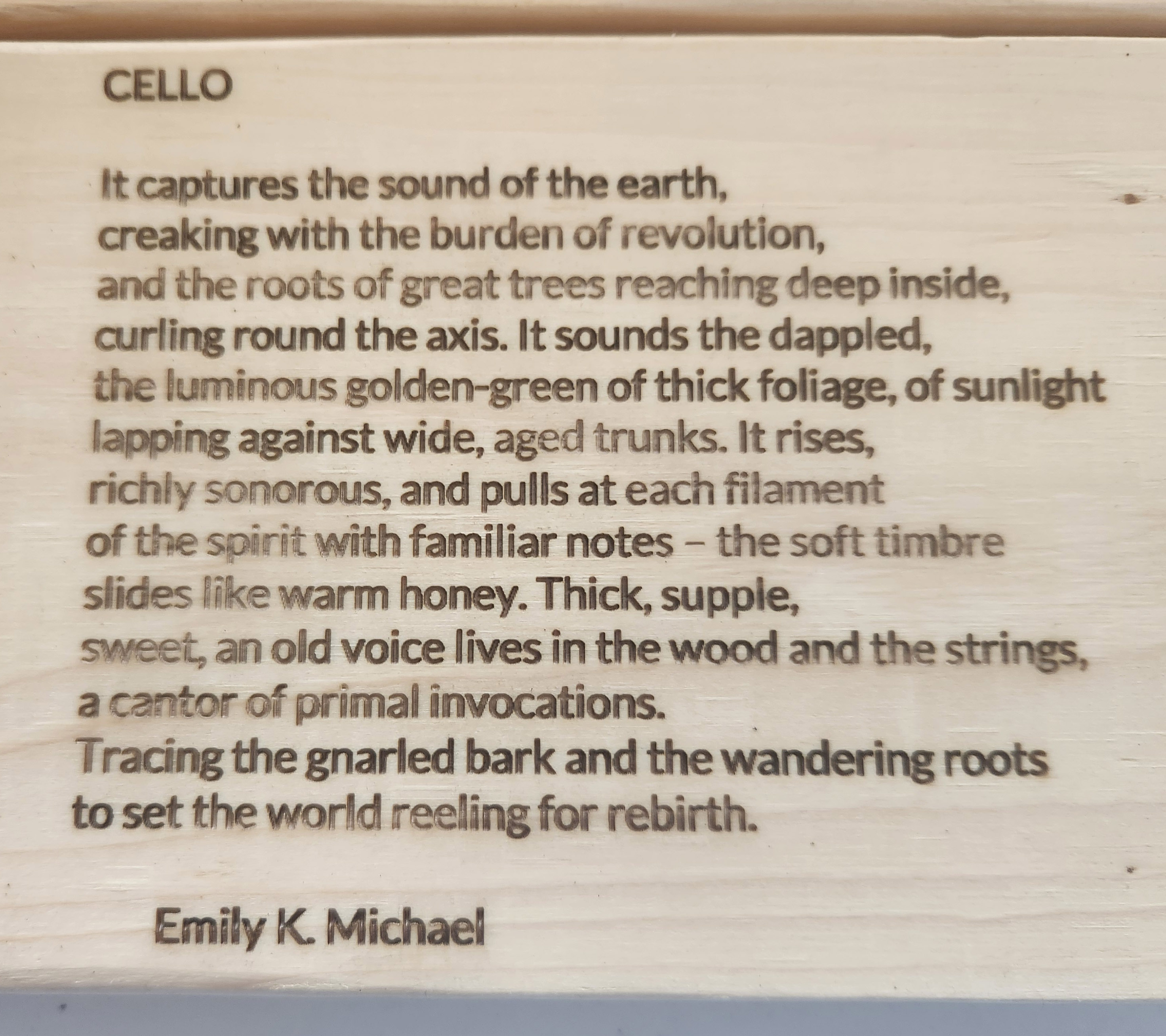
So “Cello” got its start in a print journal, moved to an online journal, landed in a hospital waiting room, and served as the final poem in Neoteny. Now, it has a new form and a new home! “Cello” has been carved into a picnic table in Cobourg, Ontario. This table is part of the POETCHRY accessible poetry exhibit that allows people to read poems while sitting at the table in the Ecology Garden. Here is a photo of “Cello” as etched by the master woodworker:
I’m proud of this poem child who has traveled far and reached many. I hope it continues to give its readers restorationn and peace.
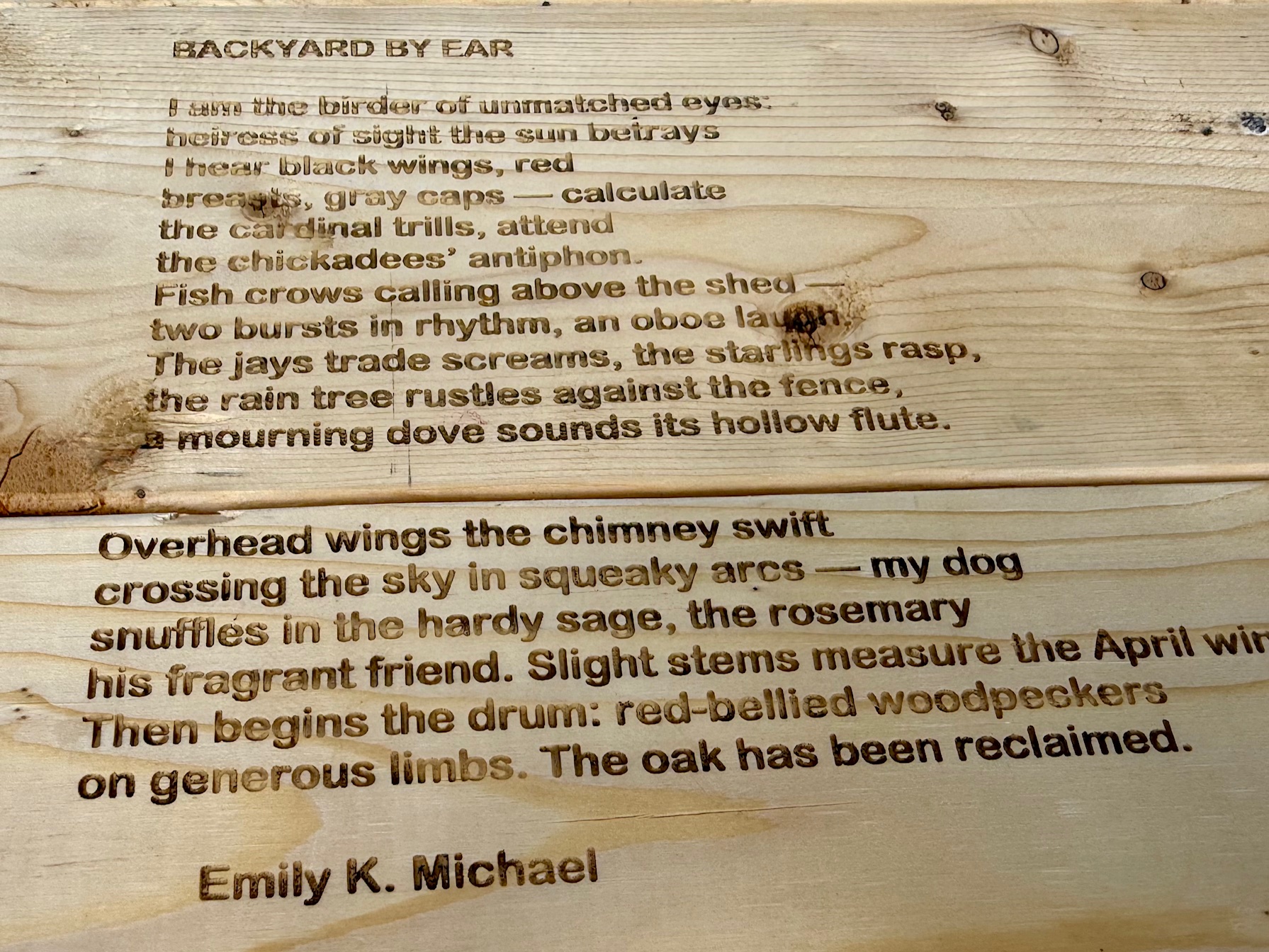
And “Cello” has a sibling, making its debut in POETCHRY, a poem called “Backyard by Ear.”
Poetry continues to change and revive us. Poetry calls us to the beauty that already exists and the beauty that we are able to build.
Several months ago, I began my foray into Tudor history. I’ve found joy in a plethora of history podcasts. In no particular order, here are the five Tudor podcasts I never miss!
Some lovely features in common with all five podcasts:
The hosts are active and responsive on social media.
The hosts stay current with reputable historians and authors.
The hosts share their episodes on YouTube.
The hosts deploy solid research to build each episode.
Talking Tudors
Hosted by Natalie Grueninger, Talking Tudors is a rich exploration of Tudor life. Natalie is the author of several books, and she frequently delivers online courses of various lengths. I’ve taken two of her week-long virtual courses, where she collaborates with other historians, and I’ve read her book, The Final Year of Anne Boleyn. Here is an episode of Talking Tudors about women writers:
The Tudor Chest
The Tudor Chest is hosted by Adam Pennington, author of Henry VIII and the Plantagenet Poles. Adam also leads Simply Tudor Tours with Sarah Morris (see bonus video below). The Tudor Chest is a home for rigorous historical discussions. Here’s one of my favorite episodes, an interview with author Helene Harrison about her new book:
Renaissance English History Podcast
Heather Teysko is the host of the Renaissance English History Podcast. As she announces in her intro, it’s the longest rrunning podcast on Renaissance English history. Heather is also the creator of Tudorcon, a 3-day conference all about the Tudors, which I’ll be attending virtually in October!
Like me, Heather loves performing chorral music, and she gives a lot of attention to music on her show. She provides a variety of episode styles, ranging from “Tudor minute” videos of 1-2 minutes to hour-long interviews. Here is her completely fascinating talk with musicologist David Skinner:
And because I love music and music history, I also enjoyed this one:
Tudors Dynasty & Beyond
I featured a video from Rebecca Larson’s Tudors Dynasty & Beyond podcast in my review of The Cardinal. On her show, Rebecca offers a variety of videos, from solo commentaries on Tudor figures to full-length author chats. Here is one of her short profiles I enjoyed:
And here is Rebecca’s in-depth conversation with Dr. Joanne Paul, about her new book on Thomas More:
British History: Royals, Rebels, and Romantics
Carol Ann Lloyd is the enthusiastic host of British History: Royals, Rebels, and Romantics, a lively show about historical figures, daily life, and significant events. An author and historian, she starts each episode with a warm welcome and audible excitement. Here is her lovely chat with historian Suzannah Lipscomb:
And another one with author and historian Tracy Borman:
More to Explore
Here are a few Tudor extras that are just so wonderful and fun!
Sarah Morris, also known as The Tudor Travel Guide, gets dressed as a Tudor lady! Where can I get this gown?
Claire Ridgway of The Anne Boleyn Files & Tudor Societydescribes a day when Henry VIII was bested by his wife — and his mistress. He just couldn’t find a sympathetic ear.
Jay Britton, The Tudor Songbook, sings Henry VIII’s “Pastime with Good Company,” a paean to youth and fun, in full Tudor costume. She has an utterly gorgeous voice!
As I prepare for my 14th year of teaching, I can anticipate one major change: my guide dog York will not be walking beside me. After 11 years of incredible service, it’s time for him to retire.
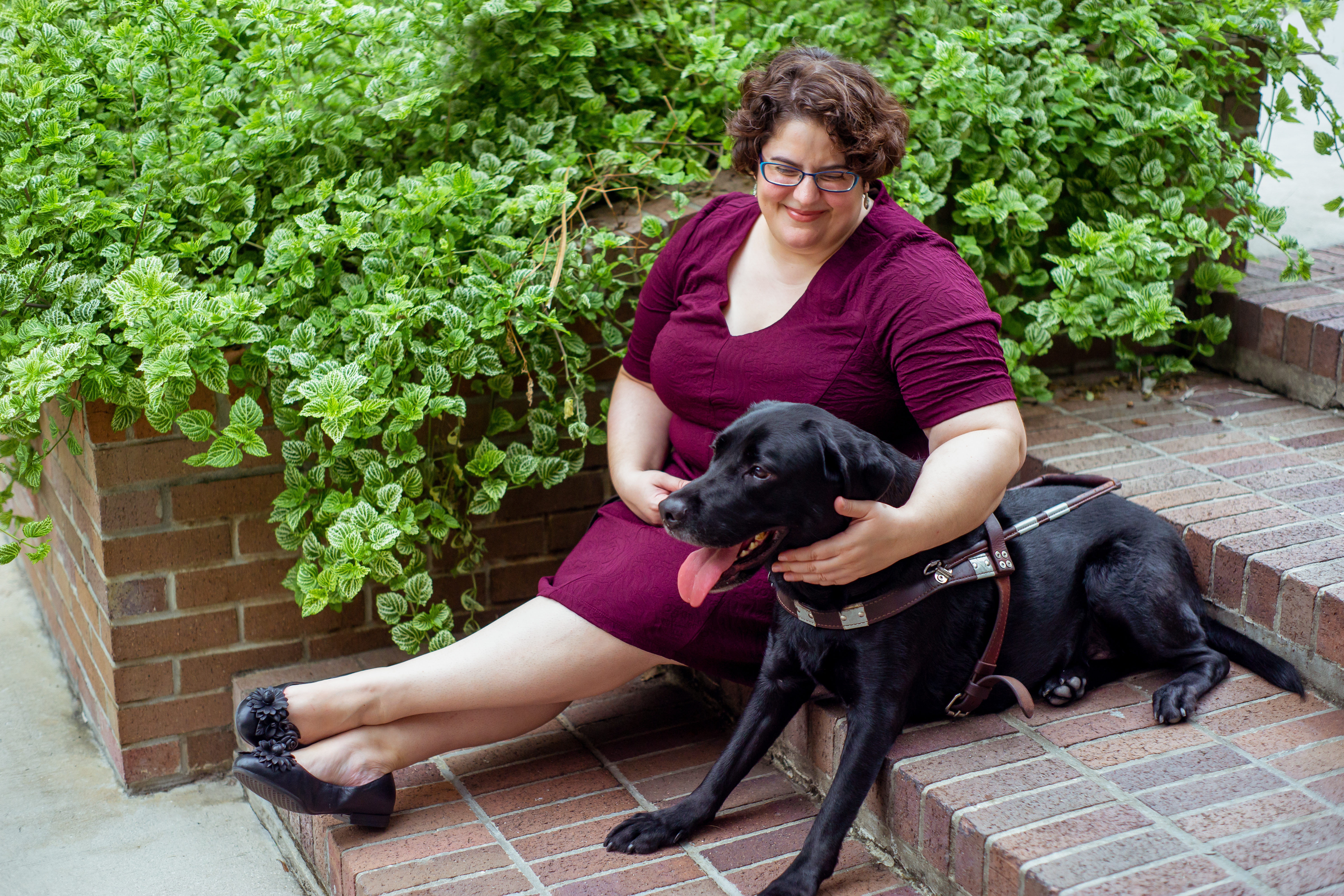
Photo by Chelsea Whiteman, 2019.
I met York on June 24, 2014, and it’s no exaggeration to say that he has completely changed my life. Since I brought him home, we’ve rarely spent more than a day apart. He has guided me through my daily routine, but he has also seen me through some extraorrdinary experriences. York guided me onstage for my TEDx Talk in 2016. He walked with my barbershop quartet at our regional competition. He helped me feel safe and confident moving to two different high school campuses. We have visited sick friends in the hospital, where he was regularly mistaken for a therapy dog. We have spoken to veterans, disability organizations, sororities, and puppy raisers. York has laid at my feet while I read my poetry in public. He has helped me navigate many stages.
I doubt I could write the tribute York truly deserves. His presence has healed scars I didn’t even realize I had. His wagging tail and eagerness to work have helped me feel adventurous and bold.
With a white cane, I traveled safely but cautiously forward for 10 years. With York, I was still blind, but I became brave. I knew he would take care of all the little things that weighed me down — walking in a straight line, seamlessly moving around other pedestrians, finding doors and seats and counterrs. He kept me safe in a larger way, because he was better at judging oncoming traffic than I ever could be. But in an equally important way, he told me every day that I was valued and loved.
No one can force a dog to work, and no one can force a dog to guide. Training is not what makes a guide dog excel. The dog needs to want and enjoy the job — and love the blind person that comes with it. If York hadn’t chosen me, I would not be writing this post today.
So I thank York for our wonderful life together. Though he’s retired, he is still my puppy, and I’ll see him when I come home each day. York is happy and healthy, loving the leisurely pace of his new life. I’ll use a white cane again until I’m ready to let another guide dog into my heart.
I’ll carry York’s confidence with me. We’ve hung up his harness for good.
Acknowledgements
York is a graduate of Dogs Inc, formally Southeastern Guide Dogs. Thank you to everyone who brought him into the world and helped him learn to be my guide dog.
York’s puppy raiser is a wise, kind woman named Melissa. She let York into her life for a year — and into her heart forever. She has been an incredible support and fellow York enthusiast.
Thank you to Chelsea Whiteman who took fabulous photos of York and me in 2019. Her pictures inspired this poem.
Thank you to the family and friends who have supported my journey with York. You’ve helped us adjust to new routines, vacuumed up tons of dog hair, stood up for us when we got kicked out of stores, picked up poop, and cheered us on.
For the past eight months, I have been rediscovering my love of medieval and renaissance history through books and podcasts. I’m having a blast! So I’m documenting my research journey here with some reviews.
Today I’m reviewing The Cardinal: A Novel of Love and Power by Alison Weir (Ballantine, 2025). I’ve read all six of Weir’s Tudor Queens series, as well as The King’s Pleasure, her novel from Henry VIII’s perspective. But I had not given much thought to the life of Thomas Wolsey, Henry VIII’s famous advisor, statesman, and cardinal.
An episode of the Tudors Dynasty and Beyond podcast put The Cardinal on my radar.
In this episode, host Rebecca Larson interviews Alison Weir about Cardinal Wolsey’s life, the arc of the novel, and the challenges of writing epic historical fiction. Weir explains how she wanted to show audiences the human side of Wolsey, which doesn’t come across in his formal portraiture. The Cardinal achieves this goal.
The novel is a fast-paced mostly chronological depiction of Thomas Wolsey’s life, beginning with his days in the schoolroom and ending (spoiler alert) with his death.
While readers may expect a plot-driven narrative, Weir’s intense attention to Wolsey’s motivations, relationships, and struggles creates a rich character study of a complex man. We meet Wolsey’s family, who exert well-meaning pressure on him as he begins his career. Weir gives unique space to Wolsey’s relationship with each parent, as well as his siblings and Uncle Edmund. Weir’s vivid descriptions place us directly into the family home in Ipswich — at the triumphant supper table and the solemn bedside of his relatives.
The novel develops an all-consuming conflict between love and power in Thomas Wolsey’s life, pitting his two most important relationships against each other. Wolsey is caught between his love for Joan Lark, his mistress, and his devotion to Henry VIII, his king. Like all compelling stories, this novel doesn’t give us one right answer. As Wolsey’s luxurious life unravels, we are invited to wonder whether the cardinal made the right choice.
By the end of The Cardinal, I discovered a profound empathy for Wolsey, Joan, and even Henry VIII. Weir’s prose is lush, gripping, and easy on the ear. I listened to this book on Audible, and narrator Rosalyn Landor is expressive and nuanced. Weir succeeds in showing a man of passion, charm, and ability in Thomas Wolsey while portraying the real danger of his rise to power.
I am no stranger to the dread of poetry. When my students enter class and see “Poem of the Week” emblazoned on the warmup slide, the groans and sighs begin. “Poetry? I hate poetry!”
Many students fear and despise poetry because it makes them feel stupid. They imagine, or have been led to believe, that poetry is an elite and obscure code they will never crack. As their teacher, I want them to fall in love with poetry and praise all its capabilities. But first, we must dismantle the cloud of negative associations they bring into my classroom.
We begin with simple poems about everyday things — food, animals, weather. I use a consistent framework for analyzing poetry. We examine images, sounds, individual words, feelings, questions, and promises — including the promise made by the poem’s title. Each time they see “Poem of the Week” on the warmup slide, they also see the same directions for annotating the poem in their hand. We focus first on poets of the last 100 years: Langston Hughes, Kimiko Hahn, Seamus Heaney, Jane Kenyon. Through our analytical routine, we start to see poems as harmonious and evocative: a series of beautifully staged causes and effects.
Rigor governs our routine examination of poems. Our warmup analyses are a low-stakes way for students to recognize that poetry can be about anything — and build confidence in discussing poetic language. With the frequency of this activity, we allow skills to replace fears; we read the poem aloud so the language can come alive. Students become excited to see which texts will appear as Poems of the Week. They even volunteer suggestions for future classes.
After we analyze a half dozen poems, I invite students to write their own. They may write strict imitations or free-flying inspirations, as long as they can talk about their process. Some beginners quickly shed their insecurities and dive into the project while others hesitate. But eventually a poetry prompt will appeal to reticent students, and they will find the enthusiasm for poetry. The enthusiasm precedes the words, and it may be the easiest part of the poetic process.
When students begin to approach poems with confidence and interest, then it is time to explore what English is and what it has been. We spend a few days looking at the ancestors of Modern English and the many English dialects that exist today. When we make a place in the writing classroom for students’ home language, they can start to imagine themselves as writers. If a student finds a reason for writing, they will write: we know the feeling when a powerful exigence drives us to the pen or the keyboard.
In my teaching, I strive to show students that they can understand and produce poetry. Whether they take delight in poetry is up to them, but I like to think that many students have discovered a joy in poetry that they did not have before. I cannot make poetry easy, but I can make it accessible. I can hold the door open and allow students to walk through it.
With advanced poetic studies, we emphasize the power and purpose of the writing process. I take students through three stages of writing: discovery, drafting, and revision. We complete classroom tasks designed to emphasize the unique function of each stage. Revising poetry can be especially daunting as we scrutinize each element of the poem’s form and content and ask, “Is this working?” But with a structured approach, a poem can undergo momentous changes and take flight.
When I have worked with individual students on revising their poetry, I explain that we are looking for that moment when the poem leaps off the page. It becomes more than words on a screen. Sometimes we can release the poem with a few formatting tweaks; other times, we need to dramatically reshape the poem’s foundational metaphors. Either way, the poem’s state of completion is a gut thing: we know it when we see it. Or, I’ve made the best poem I can at this time. That moment yields a sigh of relief as we close the file or submit the work. We have to trust the words we’ve gathered and the energy we’ve invested.
Ultimately poetry in all of its iterations is a practice of joy. Teaching, reading, writing, and revising poetry helps us develop a powerful attention and self-reflection that lets us savor the intensity of our experiences. Even when we render a challenging life event in poetic terms, we can derive satisfaction from the poem working as we intended.
When our programs are cut or our courses are canceled, we face that nasty question, “Is poetry for everyone?” But for poets, and teachers of poetry, this is not a question. It is a truth that we apply each day, a truth that drives us to create new lessons, choose diverse poems, locate something for each student. Poetry is for everyone, and with the right approach, any student can find delight in its practice.
So much of modern advice for teachers involves tuning in to students’ anxieties, fears, and moods in such a way that you are told, “Never cold-call a student,” or “Don’t give a student anxiety by asking them to read an unfamiliar passage out loud.”
I think this is a misdirected or perhaps misapplied approach to considering students’ feelings. While I never seek to actively increase a student’s anxiety, I believe that there is a value in productive discomfort. For example, if you call on a student to read a passage aloud, the “considerate” approach (advised above) would say, give them time to prepare so they don’t embarrass themselves. However, I think we are targeting the wrong feeling here: why should there be embarrassment? If they make a mistake, it is an opportunity for the class to reflect on
a) what the “mistake” actually means,
b) why the student made it, and
c) how to recover from it.
What I mean is, when we only allow learning opportunities that cater to students’ feelings of ease and calm, we are showing them that the world will give them ease and calm. When we give a student a challenging academic task and stand beside them through that task, we are showing them that these feelings of anxiety and fear can be accommodated — that a resilient learner accepts the negative feelings and works with them.
I believe that learning should be enjoyable and safe, and I do agree that students learn best in a trusting environment. However, rigor and difficulty are not the absence of trust. It is a sign of trust if someone believes I can do a difficult task and stands beside me while I do it…rather than watering down the task until I am comfortable with each stage.
Life after school will not wait for you to feel calm before throwing crap at you. Building a supportive and loving classroom means establishing non-negotiable rules of civility in the presence of difficulty, not the absence of it.
This post is part of The Learning Curve, my column on teaching and learning. In these posts, I’ll share experiences and research from college and high school teaching.
I’m excited to announce that the Winter 2023-2024 issue of Wordgathering: A Journal of Disability Poetry and Literature is live. This issue boasts reviews for 11 books, and included among these is my review of Clark A. Pomerleau’s Every Day, They Became Part of Him. I first encountered Pomerleau’s exceptional poetry when he submitted to Wordgathering, and I am thrilled to see him publish this second collection with Finishing Line Press, who published his first chapbook, Better Living Through Cats. If you click that link, you’ll see that I wrote a blurb for his first book, and I’m so happy to offer a full-length review of this new one!
Here’s how the review begins:
“Language is our strength.”
This powerful line is tucked into the middle of “Sharp,” a modest poem from Clark A. Pomerleau’s new collection, Every Day, They Became Part of Him. While these poems revisit grief, nature, family, and identity, Pomerleau constantly adjusts the focus, the zoom lens, the intensity of feeling. He offers a panorama of stones, pines, and rivers and follows birds from the ground; he walks beside Walt Whitman and Jericho Brown. And in “Sharp,” he sits us close to a child-self, vulnerable to the heft and angle of language:
“He sharpened my tongue as a weapon against bullying. Tuned my timbre to ring with shrewd contempt if attacked.… I was tender and needed to parry in defense. Then.“
In microcosm, this poem speaks to its neighbors as Pomerleau searches for “crumbs of identity” in a “soup of stories.” Words like “bullying” and “tender” attach themselves to the brave openness that Pomerleau allows in the more challenging poems of this collection. But weaponized language does not cast this book in a haze of violence.
It’s been a long time since I’ve updated this blog, but I am happy to write today with an exciting announcement. I have decided to promote other valuable writers’ work alongside my own. Today, I bring to you the work of John Lee Clark, a treasured friend and colleague who has always supported and encouraged me.
John’s New Book: Touch the Future
A revelatory collection of essays on the DeafBlind experience and the untapped potential of a new tactile language.
Born Deaf into an ASL-speaking family and blind by adolescence, John Lee Clark learned to embrace the possibilities of his tactile world. He is on the frontlines of the Protactile movement, which gave birth to an unprecedented language and way of life based on physical connection.
In a series of paradigm-shifting essays, Clark reports on seismic developments within the DeafBlind community and challenges the limitations of sighted and hearing norms. In “Against Access,” he interrogates the prevailing advocacy for “accessibility” that re-creates a shadow of a hearing-sighted experience, and in “Tactile Art,” he describes his relationship to visual art and breathtaking encounters with tactile sculpture. He offers a brief history of the term “DeafBlind,” distills societal discrimination against DeafBlind people into “Distantism,” sheds light on the riches of online community, and advocates for “Co-Navigation,” a new way of exploring the world together without a traditional guide.
Touch the Future brims with passion, energy, humor, and imagination as Clark takes us by the hand and welcomes us into the exciting landscape of Protactile communication. A distinct language of taps, signs, and reciprocal contact, Protactile emerged from the inadequacies of ASL—a visual language even when pressed into someone’s hand—with the power to upend centuries of DeafBlind isolation.
As warm and witty as he is radical and inspiring, Clark encourages us—disabled and non-disabled alike—to reject stigma and discover the ways we are connected. Touch the Future is a dynamic appeal to rethink the meanings of disability, access, language, and inclusivity, and to reach for a future we can create together.
John Lee Clark is an award-winning writer and Protactile educator. He has received the Krause Essay Prize and a National Magazine Award for his prose, and the Minnesota Book Award for his poetry collection How to Communicate. A 2021–2023 Bush Fellow, he lives in Saint Paul, Minnesota, with his partner, the ASL Deaf artist Adrean Clark, their three kids, and two cats.
Praise for Touch the Future
“John Lee Clark’s fervent manifesto for the Protactile language and movement will blow your mind, enliven your body, and connect you to other people in unexpected ways. Touch the Future is a book that enlarges the human world.”—Edward Hirsch, author of Stranger by Night
“John Lee Clark writes against the grain with intellectual ferocity and dry wit; with linguistic playfulness and unsparing precision; and above all, with an expansive, curious, tireless compassion. Society may ignore and isolate DeafBlind people, but as Clark shows us again and again, it is the sighted and hearing world that is marginalized by its failure to understand DeafBlind life, and never the other way around.”—Andrew Leland, author of The Country of the Blind
“John Lee Clark’s essays radiate with excitement and urgency. . . . To read Clark is not simply to be taught something by him, but to find yourself immersed and seeking alongside him—you don’t just learn, you come away changed.”—Katie Booth, author of The Invention of Miracles
“Touch the Future opens doors to the multiple worlds of disability. . . . This is a book for anyone who is interested in the life of the imagination and the mind.”—Stephen Kuusisto, author of Eavesdropping
“John Lee Clark is equal parts master storyteller, wry comedian, erudite historian, and brilliant teacher. . . . At times urgent, often hilarious, and always illuminating, Touch the Future will touch readers’ hearts while opening their minds to a whole new world.”—Robert Siebert, co-author of Deaf Utopia
“Protactile leads the way in this exquisite book that invites us into the curious and joyful crafting of choreographies of encounter. . . . This is not a book to hold at a distance. This is a book that teaches us how to get into the tangle, knee against knee, hand enthusiastically tapping the thigh, to feel the world differently.”—Erin Manning, author of For a Pragmatics of the Useless
“Through John Lee Clark’s writing, we witness the emergence of a new language, new sensibilities, new art forms, new forms of embodiment and sociality—nothing less than a new mode of existence. Clark’s eloquent writing brings to voice one of the most significant cultural movements of our time.”—Brian Massumi, author of Parables for the Virtual
I am so thrilled to be part of the Arts Society of Kingston’s Poetic License exhibit! In this exhibit, Poetry Barn editors offered ASK artists a selection of poems to turn into works of art. I submitted in March, and my poem “Deficiencies” was chosen by the editors — and chosen again by artist Pamela Timmins! She created a watercolor called “Sudden Urge to Tumble,” borrowing a line from the poem as her title. The watercolor is playful with the air of a children’s book illustration.
You can read the poem, see the painting, and listen to my audio here. Be sure to scroll through the gallery and see all the lovely poems and artwork. I participated in a Zoom reading with these poets today, and I was so impressed by their work. I hope you enjoy it, too!
I’m excited to share that one of my poems is featured today as Split This Rock’s Poem of the Week. The poem, “Blindness Locked Me Out,” first appeared in my book, Neoteny, back in 2019. You can read the poem and listen to me reading it here.
I had fun writing this poem. I wanted to create a casual style, like a found note or diary entry — something scribbled in a hurry. While the poem describes situations where my blindness made me an outsider, any poet knows that being an outsider means you have more room to observe what is going on. And that’s what I tried to do here. I hope you enjoy it!
I am excited to report the release of Welcome to the Resistance: Poetry As Protest, a new poetry collection from Stockton University Press. This collection was edited by Taylor Savath and Ona Gritz, and it includes three of my poems: “A Phenomenology of Blindness,” “Strangers at the Coffeeshop,” and “I Bless Our Daughter.”
Here’s me, holding up a copy of the book and smiling. Me, enthusiastically reading the book!
It’s never too early to start celebrating National Poetry Month!
I’ll be reading at this fun event from the National Braille Press! All the info is below.
It’s been a tough year! In honor of National Poetry Month, the National Braille Press is offering a poetry circle by Zoom with the theme of “Poems of Hope” on April 22, 2021 at 7pm EST. Come, read a poem you wrote, or a favorite poem that gives you hope. Or come and listen; all are welcome. Let us know if you want to share a poem and we’ll be in touch. All who register will be given a Braille copy of “The Hill We Climb” by Amanda Gorman and some resources for more wonderful poetry.
Emily K. Michael is a blind poet, musician, and writing instructor. She serves as the poetry editor for Wordgathering at Syracuse University. She is also a poetry mentor in AWP’s Writer to Writer program. Her work focuses on music, embodiment, teaching, and ecology. Emily is passionate about birds, medieval history, singing, and guide dogs.
Pre-order My New Book
Purchase Neoteny
Email Subscription
Enter your email address to subscribe to On the Blink and receive new posts by email.